
Home / Plumbing Help / FAQ
Straight answers to real questions
Twenty-eight of the questions Valley homeowners actually ask us, answered honestly, with no upsell attached.
Service & scheduling
How quickly can you get to my home?
During business hours (Monday through Saturday, 8 AM to 5 PM) we can often reach Phoenix, Paradise Valley, Scottsdale and nearby communities the same day. Urgent leaks and no-hot-water calls are prioritized. Call or text (602) 869-5005 and we will give you an honest arrival window, and actually keep it.
Do you serve gated communities and HOAs?
Yes, daily. We handle gate access, HOA vendor registration and certificates of insurance routinely for communities like Silverleaf, DC Ranch, FireRock and the Biltmore Estates. Just mention your community when booking and we take care of the paperwork.
Do you send a text before arriving?
Always. You receive a heads-up message when your technician is en route, so you are never waiting on an open-ended "sometime between 8 and 5" window.
Can I book service if I am not home?
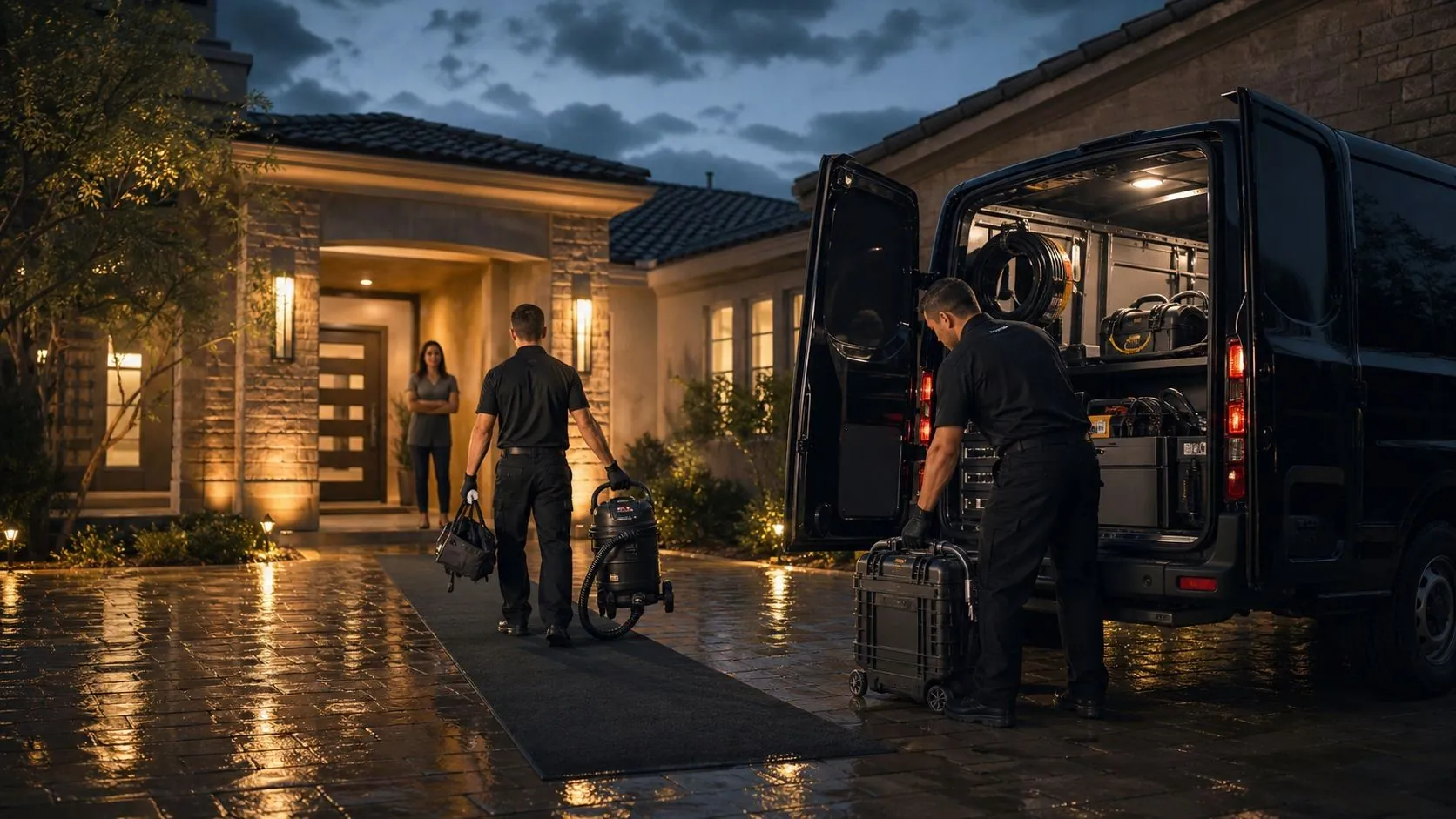
Yes. Many of our clients authorize access through a house manager, lockbox or smart lock. Every technician is background-checked and uniformed, we document the work with photos, and we walk you through everything by phone afterward.
Do you work Sundays?
No, we are closed Sundays as a matter of faith and family. Monday through Saturday, 8 AM to 5 PM, we are fully at your service.
Water heaters
How long does a water heater last in Arizona?
Expect 6 to 10 years from a tank water heater in the Valley, shorter than the national average because our hard water accelerates sediment buildup and anode rod consumption. Tankless units last 15 to 20 years when descaled annually. If your tank heater is past year 8, replacement is usually wiser than repair.
Should I go tankless in Phoenix?
Often, yes. Tankless units deliver endless hot water, free up garage space and last roughly twice as long as tanks. The caveats: they cost more up front, may require a gas line upsize, and in our hard water they must be descaled yearly. For larger homes we frequently install two units in parallel. See our full tankless guide under Plumbing Help.
Why does my hot water run out so fast?
Usually sediment. Phoenix water is extremely hard, and a few years of mineral accumulation can silently claim a third of your tank’s capacity while burying the lower element or burner. A flush sometimes helps, but heavy accumulation in an older tank generally means it is time to replace.
Why is my water heater making popping or rumbling noises?
That is steam escaping through a sediment layer on the bottom of the tank, the classic Phoenix hard-water symptom. It forces the burner to overwork and shortens tank life. If flushing does not silence it, the sediment has hardened and the clock is ticking.
What size water heater does a large home need?
It depends on simultaneous demand, not square footage: number of bathrooms, tub sizes, rain heads and appliances running at once. Estate homes often need a 75-gallon tank, twin tankless units, or a recirculation loop so hot water arrives instantly at distant bathrooms. We calculate it properly rather than guessing.
Do you install recirculation pumps?
Yes. If you wait 45 seconds for hot water at the far end of the house, a recirculation system fixes it: instant hot water at every tap, with timer or on-demand controls so it does not waste energy overnight.
Leaks & slab leaks
What are the warning signs of a slab leak?
Warm spots on the floor, the sound of running water when everything is off, an unexplained jump in your water bill, low water pressure, cracks in tile or baseboards, and a water meter that spins with all fixtures closed. Any one of these in a slab-built Valley home deserves a same-week inspection. See our full guide under Plumbing Help.
How do you find a leak without tearing up my floors?
Electronic acoustic detection, pressure isolation testing and thermal imaging let us pinpoint a leak to within inches before anything is opened. In luxury homes with travertine, marble or wood flooring, that precision is the difference between a surgical repair and a demolition.
Is a slab leak covered by homeowners insurance?
Frequently the resulting damage (flooring, drywall) is covered, while the plumbing repair itself may not be; policies vary. We document everything with photos and a written diagnosis to support your claim, and we can coordinate directly with your adjuster.
Should I repair the leak or repipe the house?
One pinhole leak in 30-year-old copper is rarely the last. As a rule of thumb: first leak, repair it; second leak in a different spot, start pricing a repipe. We give you both numbers honestly so you can decide with full information rather than fear.
My water bill doubled. What now?
Check the water meter with everything off: if the low-flow indicator moves, water is escaping somewhere, commonly a slab leak, a running toilet flapper, or an irrigation line. A running toilet can waste 200 gallons a day silently. We can isolate the culprit in a single visit.
Drains & sewer
Why do my drains keep clogging?
A drain that clogs repeatedly has an underlying cause: grease accumulation, root intrusion, a bellied line or scale buildup. Snaking punches a hole through the problem; hydro-jetting and a camera inspection actually solve it. We diagnose before we recommend.
What is hydro-jetting and is it safe for my pipes?
Hydro-jetting scours the full diameter of the pipe with high-pressure water, restoring it to near-original capacity: no chemicals, no abrasion damage. We camera-inspect first to confirm the line can handle it, which is exactly why older clay or compromised lines get a different approach.
Should I use chemical drain cleaners?
Please don’t. Caustic cleaners generate heat that damages pipes and seals, rarely clear the real blockage, and make the line hazardous for whoever works on it next. A proper mechanical clearing costs little more and actually lasts.
What is that sewer smell in my bathroom?
Usually a dried-out P-trap in a rarely used drain (run water in it weekly), a failed toilet wax ring, or a blocked roof vent. Occasionally it signals a cracked sewer line under the slab. If refilling traps does not solve it within a day, have us smoke-test or camera the line.
Water quality & treatment
How hard is Phoenix water, really?
Among the hardest of any major U.S. metro, commonly 12 to 20+ grains per gallon. That white crust on your faucets and glass shower doors is calcium and magnesium, and it is quietly doing the same thing inside your water heater, appliances and fixtures.
Will a water softener protect my fixtures and appliances?
Dramatically. Softened water stops scale from etching designer fixtures, extends water heater and appliance life by years, keeps glass enclosures spot-free, and is noticeably gentler on skin and hair. For homes with polished nickel, brass or matte-black fixtures, we consider it essential protection.
What is the difference between a softener and a filtration system?
A softener removes hardness minerals (calcium, magnesium) to protect plumbing and fixtures. Filtration (carbon, reverse osmosis) targets taste, odor, chlorine and contaminants for drinking. Most Valley estates run both: whole-home softening plus an RO tap at the kitchen. We size and install both.
Is Phoenix tap water safe to drink?
It meets federal standards, but chlorine taste and mineral content leave plenty of room for refinement. A reverse-osmosis system at the kitchen sink delivers bottled-quality water for pennies a gallon, the standard finishing touch in the luxury kitchens we serve.
Pricing, licensing & guarantees
How does your pricing work?
Flat-rate, approved in advance. We diagnose, explain what we found in plain English, and present the price before any work begins. The number you approve is the number you pay: no hourly meter running, no surprise line items.
Are you licensed, bonded and insured?
Yes. Prodigal Son Plumbing AZ LLC is licensed, bonded and insured in Arizona. We are glad to provide license details and certificates of insurance for HOAs, property managers and general contractors.
Do you guarantee your work?
Every repair and installation carries our workmanship guarantee, alongside the manufacturer warranties on equipment we install. If something we did is not right, we return and make it right. Period.
Do you offer free estimates?
For straightforward, visible work (water heater replacement, softener installation, fixture swaps), yes, we quote at no charge. Diagnostic work (finding a hidden leak, camera-inspecting a sewer) carries a fee that is credited toward the repair when you proceed.
Why choose a luxury plumber over the cheapest bid?
Because plumbing failures are asymmetric: the money saved on a cheap install is a rounding error against the flooring, cabinetry and drywall a bad joint can destroy. You are not paying for a fancier wrench; you are paying for the discipline, materials and accountability that make sure you never meet the downside.
Still wondering about something? Call or text (602) 869-5005. We answer plumbing questions for free, even when there’s no job attached. Or dive deeper in our guides: slab leak warning signs, tankless water heaters in Arizona, and what hard water does to fine fixtures.